Queen of the Night: Alina Akbar, Haji Cash & Carry, and the Private Revolt of Muslim Girlhood After Dark
Words by Jack Clarke @clarkeofsalford
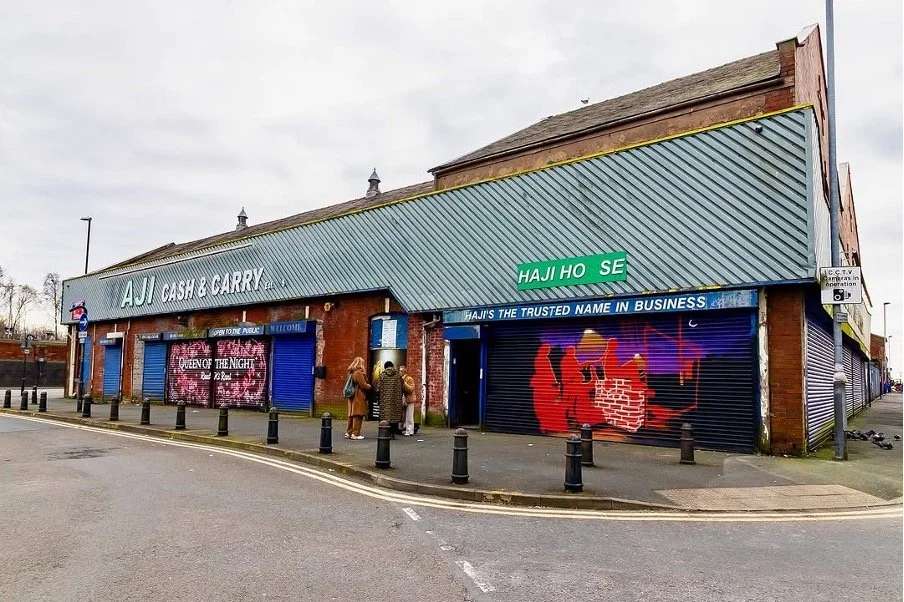
A wideshot from the outside of Haji Cash & Carry where the exhibition took place
Credit: d.w3rt
I’d only just dragged myself back from Birmingham, where I’d been buried for months alongside everything else, back and forth like a cultural mole on a Red Bull powered e-scooter, trying to make a national exhibition breathe inside a hotel that felt like it had never once been breathed in. You know the type. Conference carpet that eats sound. Air con that hums like it’s thinking for you. Work that starts to behave itself whether you want it to or not. Me and my partner in curatorial crime and design Ciara staggered out of it half-delirious, carrying the usual post-show cocktail of exhaustion, low blood sugar, and whatever psychic residue gets left behind when you spend too long making culture behave itself for institutional consumption.
I did, however, have a genuinely lovely munch box from Smashed & Stoned on the way, which I’ll defend here for the record.

A screenshot from my munch box order
Credit: Photograph by the author
So by the time I was heading to Rochdale that evening, up to my neck in admin and running on fumes, I wasn’t expecting to feel much at all.
Then I walked into Haji Cash & Carry.
Alina Akbar’s Queen of the Night doesn’t ease you in. It doesn’t need to. The building does half the work. Haji’s isn’t a neutral container dressed up as one. It’s got a memory to it. The place has been there since the 50s, part of what has been described as Rochdale’s own Little Pakistan, and you can feel that immediately. The aisles, the signage, the smell of food and plastic and time passing through it. Nothing about it has been flattened into a generic art space.
I’ve been reading a lot of Henri Lefebvre lately, mainly because once you start curating outside the comfort of galleries, you realise pretty quickly that space isn’t just where things go, it’s part of what they are. Lefebvre breaks it down into three strands: what we physically do in a space, how it gets designed and talked about, and how it’s actually lived and felt. Most exhibitions only really deal with one of those. This one holds all three at once without announcing it.
The shop still functions as a shop. People are still moving through it in their own rhythms. But it’s also been gently bent into something else. You’re aware of the building as a place people rely on, not just visit. That changes how you stand in it. You don’t drift. You pay attention differently.
Alina’s work sits inside that without trying to dominate it.
She’s working across film, photography, installation, bits of text, bits of sound. Nothing feels over-explained. It all comes from a very specific place: late-night car conversations with young Muslim women. Not interviews. Not case studies. Just the kind of conversations that happen when you’re parked up somewhere you shouldn’t really be, with time stretching out in front of you.
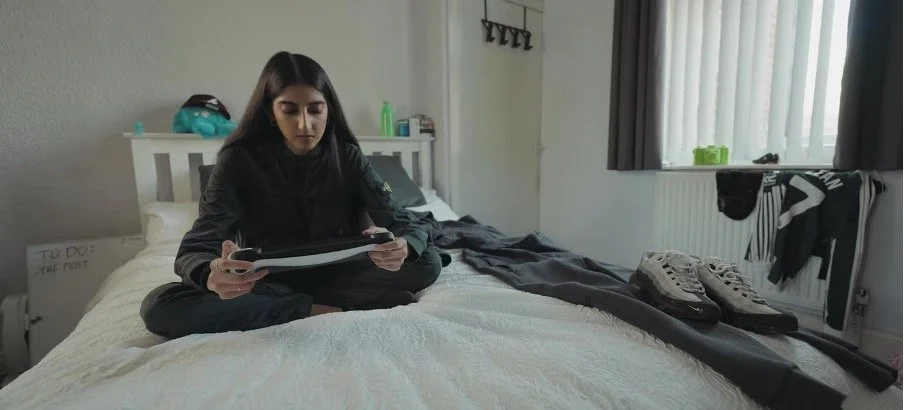
A still image taken from The Art of Authenticity with Visual Artist, Alina Akbar
Credit: Alina Ackbar / SEVENSTORE
What Lefebvre meant when he wrote that space isn’t neutral, it’s produced. Built by routines, power, memory, desire, fear, repetition. Not just brick and concrete - but lived feeling. You can’t lift this show out of Haji’s and drop it into a polished gallery in London without losing half its soul. Alina knows that. Culture Co-op knows that too. Fair play to them for commissioning something that actually trusts the local rather than treating it like a quaint bit of seasoning.
At the centre of the exhibition is a Nissan Micra, which might be the most honest sculpture I’ve seen in months. I’ve seen plenty of exhibitions with things pretending to be profound. Less often do you see a car just allowed to be what it already is, a private third space. Not the house. Not the street. Something in-between. A temporary republic of soft rebellion. It made perfect sense to root the whole thing there.
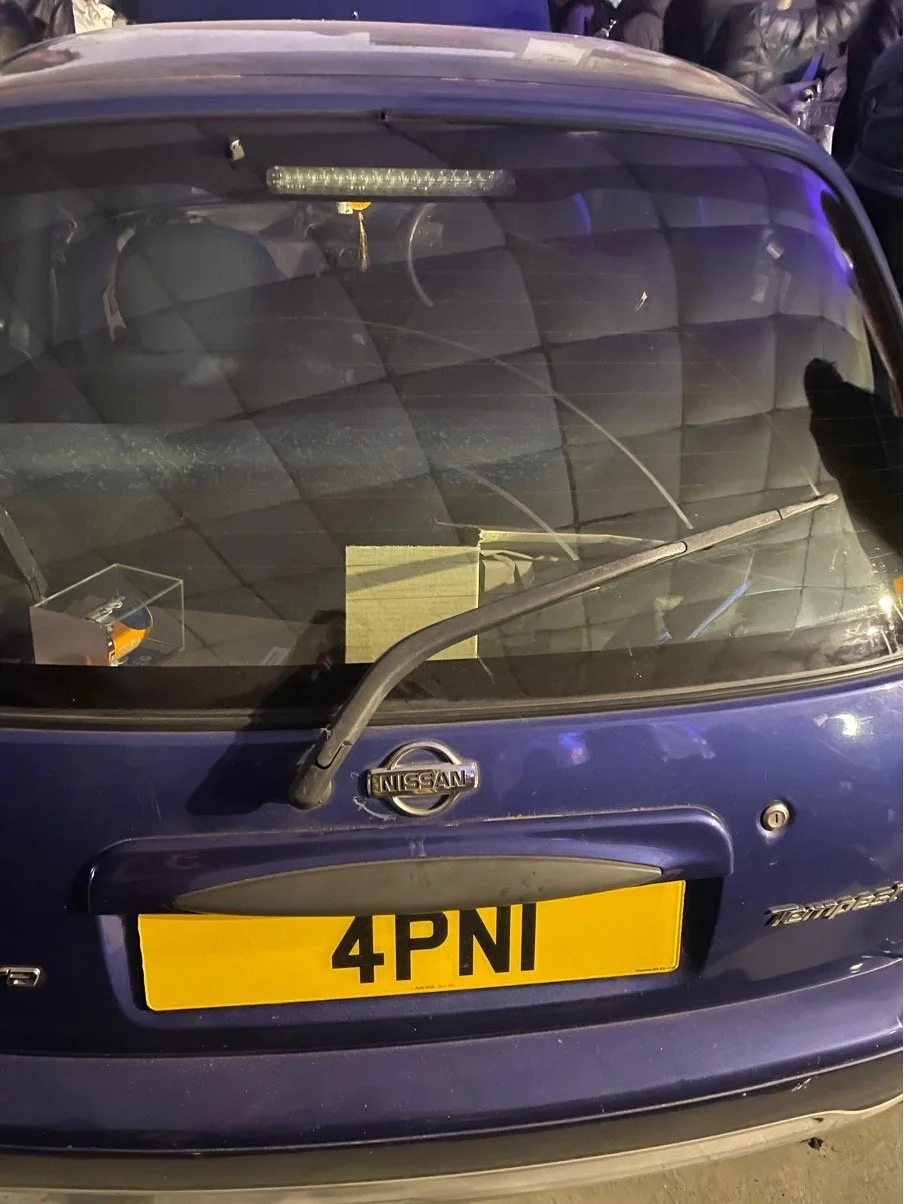
The back of the Nissan as it was featured in the Exhibition
Credit: Photograph by the author
I’ve spent enough time in and around cars in Greater Manchester to know they’re often where real life happens. In Kersal growing up, then later knocking about Cheetham Hill in the early 2010s, the car was never just transport. It was a shelter. Smoke machine. Therapy room. Sound system. Bad decision incubator. Democratic chamber of crap and crisp, with hypnotic LED under your feet as life reducing cheese and chilli sauce oozes onto your knees. The amount of life that has happened in parked up Corsas, Micras and whatever else still has one working speaker is probably enough to fill the national archive. It’s ordinary until you try and describe it, and then you realise how much of life sits in those moments.
And if I’m honest, when writing about South Asian stories it’s easy to fall into the trap of only talking about lads. Countless times I was in the whip with my lad Kash on the way to Burgerism after uni, windows steaming, talking complete bollocks one minute and the biggest questions in the world the next. That sort of intimacy, stupid and profound at once, gets mythologised more easily when it belongs to men. Women’s versions of those spaces often go undocumented, or else they get flattened into moral panic. That’s part of what makes Alina’s exhibition hit so hard. It gives that after-dark interiority to Muslim girlhood without explaining it to death or sanding off its contradictions for a liberal audience.
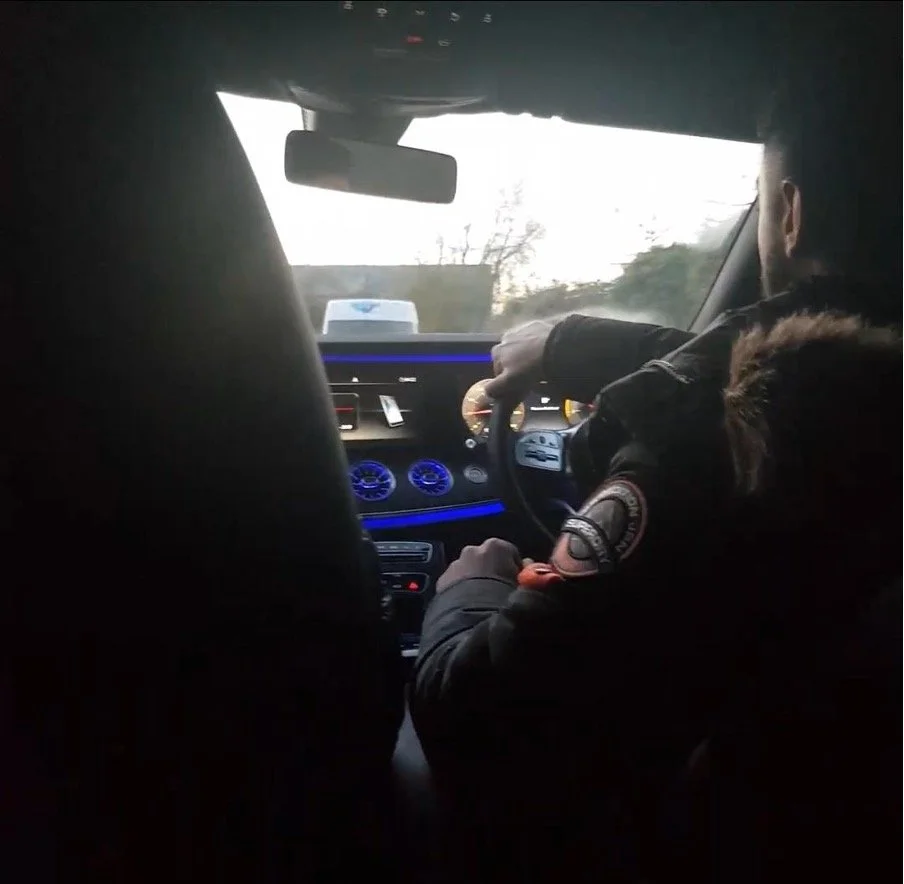
Taken from my phone archives in 2019 in the back of Kash’s car.
Credit: Photograph by the author
The sound work does a lot of heavy lifting here. Carrying voices of young south asian women talking about freedom, fear, relationships, family expectations. It’s not polished. It doesn’t sound like it’s been cleaned up for an audience. There’s humour in it, awkwardness, pauses where you can feel someone deciding how much to say. It reminded me of something from Pedagogy of the Oppressed that’s stuck with me since Basit Khan put me onto it years ago like a knowing older brother slipping you a book that might rearrange your head a bit. Paulo Freire talks about dialogue not as performance but as a mutual process of becoming more human together. Not people being spoken for, not culture being deposited into passive bodies like loose change into a machine, but knowledge produced collectively through shared experience and contradiction. That spirit runs right through this show. These voices aren’t illustrative. They are the work. The girls are not subjects dragged into visibility by the artist. They are co-producers of the atmosphere, its intelligence, its refusal.
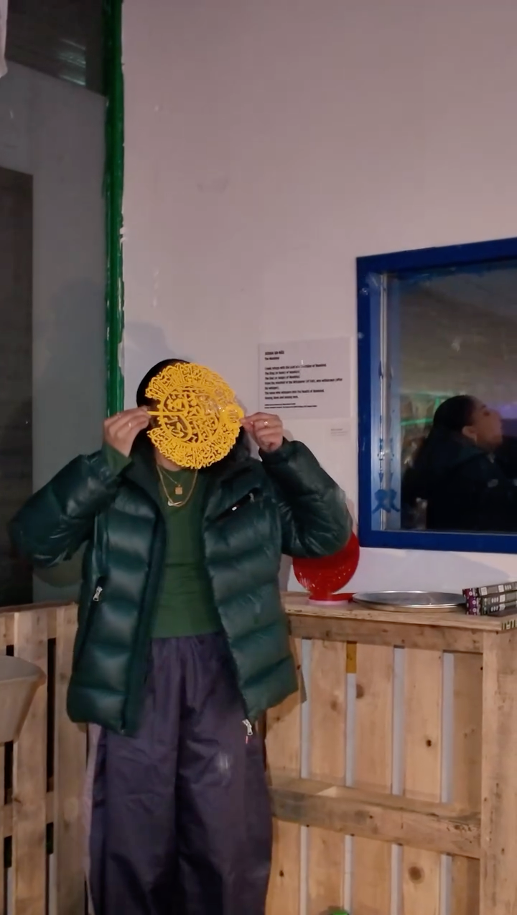
Alina holds a 3D-printed calligraphy bubble wand up to the camera, mid-demonstration
Credit: Alina Akbar
One of my favourite pieces in there was Blow and Bless, these 3D printed bubble wands in Islamic calligraphy, accompanied by Surah An-Naas. As she talks about in one of her many playful behind the scenes videos on her socials, Alina’s mum used to read a dua for protection and blow on her, and here that act becomes reimagined as sculpture, invitation, memory and play. You’re encouraged to blow them yourself. Which is such a beautiful gesture because it turns protection into something tactile and shared, but it also keeps the childlike weirdness of it alive. That’s something Alina is very good at. She understands that ritual can be tender, funny, and slightly surreal all at once. It doesn’t have to be flattened into solemnity to be taken seriously. Same goes for the giant inflatable pink vape, which I adored. A ridiculous and perfect object. Devotional symbolism colliding with youth iconography. Sacred protection meeting Elf Bar culture.
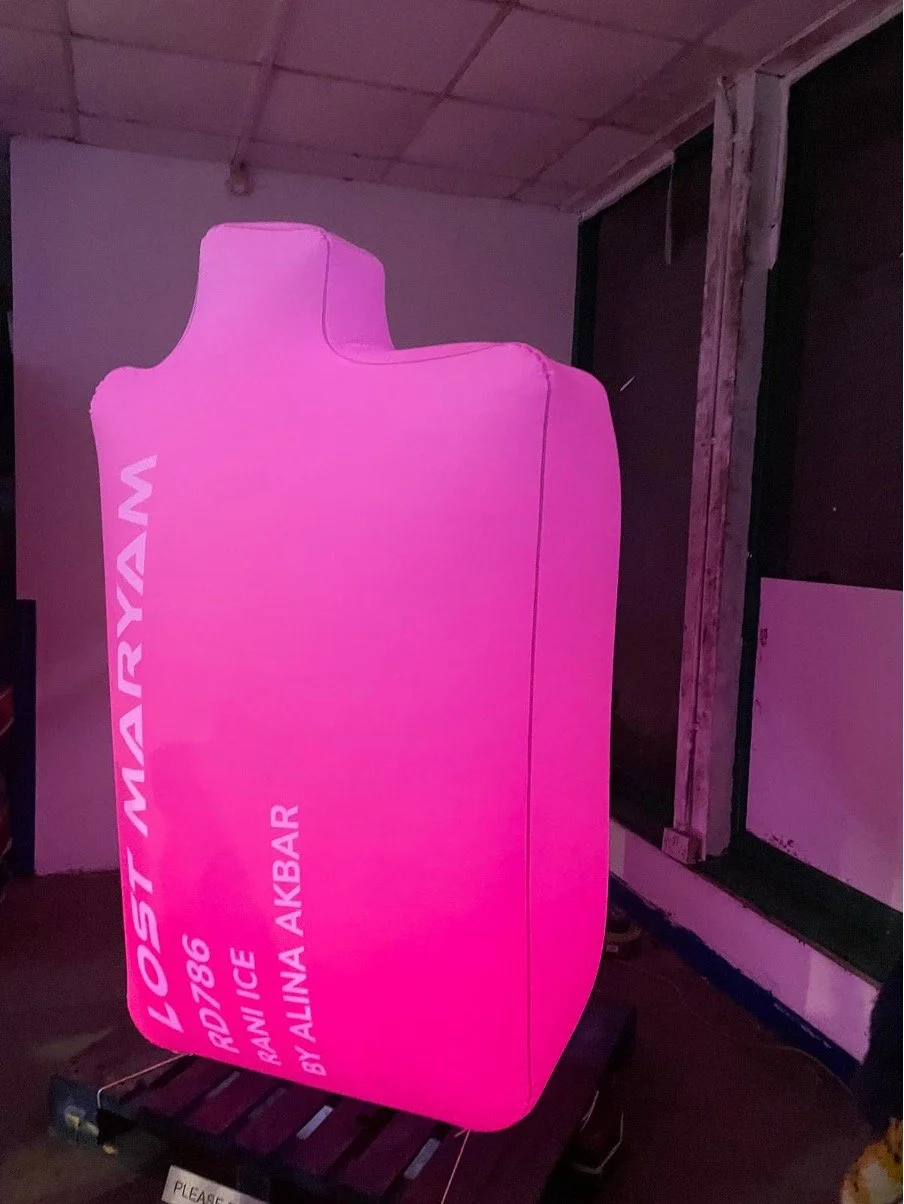
A giant pink inflatable vape sits in the exhibition space, oversized and slightly absurd, hovering between devotional symbol and corner-shop icon.
Credit: Photograph by the author
And yes, I have to salute her for being perhaps the first person to put Miami Crispy into an exhibition. Big up the spicy dip burger. That, in itself, felt like a small curatorial victory for the people.
The projected film was gorgeous too. Street lights, night driving, the hush and blur of movement after dark, all thrown across these beautiful translucent white sheets. But what made it unforgettable wasn’t just the image. It was the life happening in front of it. Aunties sat there talking away, completely engrossed in their own conversation, oblivious to the footage. At one point one of them stood in such a way that the dashboard and car wheel were projected directly onto her back, as if she herself were driving through the night, still listening keenly and chatting with the women around her. It was one of those accidental perfect moments you couldn’t choreograph if you tried. The exhibition folding back into the social life it came from. Art not floating above people but moving through them.
Find out more about Alina’s recent exhibition here:
Alina Akbar’s art captures the soul of British working-class culture
Read more by Jack here:
Instagram: @clarkeofsalford
Substack: www.clarkeofsalford.substack.com